

Washing your hands, changing clothes, cleaning equipment between each horse…
These measures are essential. But when faced with a highly contagious disease such as equine rhinopneumonitis, they are no longer enough on their own.
Today, stables, equestrian centers, and breeders are faced with a worrying reality: contamination is invisible, but it circulates continuously.
So how can we truly break the chain of transmission?
By moving from occasional disinfection to permanent prevention.
Equine rhinopneumonitis: invisible but permanent contamination
Equine rhinopneumonitis (EHV-1) is transmitted:
Through direct contact between horses
Through indirect contact via:
– Textiles (blankets, clothing, rugs)
– Surfaces (stalls, partitions, feeders)
– Vehicles (vans, trucks)
– Shared equipment (brushes, buckets, halters)
The problem?
The virus can survive on these surfaces and circulate between cleanings, even when protocols are followed.
The limitations of traditional disinfection protocols
Even with impeccable hygiene:
– Traditional disinfection only works for a few minutes or hours
– A surface that is touched again immediately becomes susceptible to contamination
– Washed textiles are clean… but not protected over time
The result: contamination resumes upon first contact.
Real-life example of chain contamination
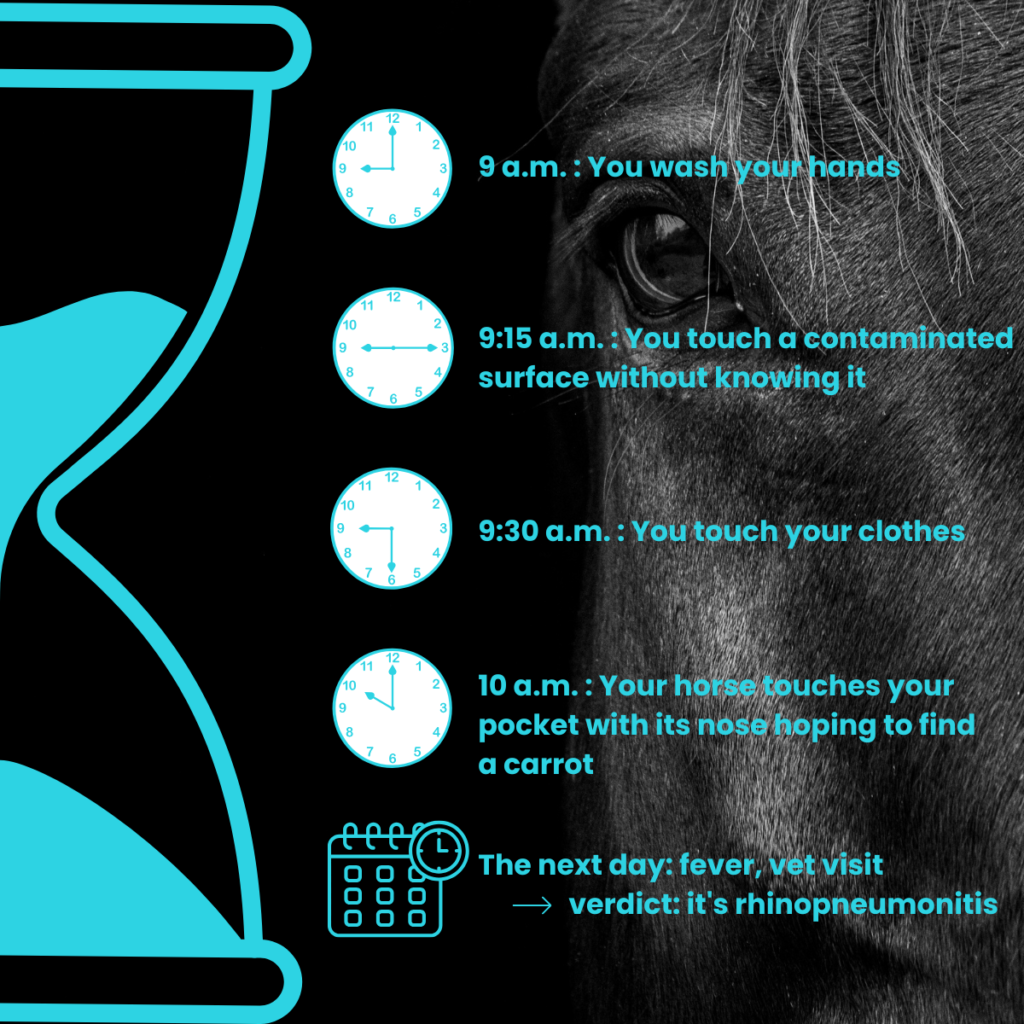
This is how:
– The spread remains silent.
– Asymptomatic horses infect others.
– Outbreaks go from 2 to 9 cases in a few days.
– Competitions are canceled and equestrian centers are closed.
What if disinfection became continuous?
That’s exactly what PhotoACTIVE Equine offers.
Unlike conventional disinfectants, this technology doesn’t just clean: it provides long-lasting protection.